

Word Solitaire Go
Nebula Studio
I approached Word Solitaire Go expecting a light word game, but its real appeal is the way it turns sorting letters into a calm, solitaire-like routine. Instead of asking me to race through a dictionary or compete against other players, it gives me small word-grouping problems that are easy to understand and satisfying to tidy up. That makes it a comfortable choice for a short break, especially when I want something more engaging than passive scrolling but less demanding than a strategy game.
This is a free word game from Nebula Studio, rated for Everyone and available for devices running Android 7.1 or later. Its current version is 1.1.0, and the game has already passed over 100 thousand installs with an average rating of 4.9 from around 2.7 thousand ratings. Those figures suggest that the basic idea connects with a broad audience, although I still think the best way to judge it is by looking at how its goals, pacing, and long-term motivation work in everyday play.
How the first sessions establish a steady rhythm
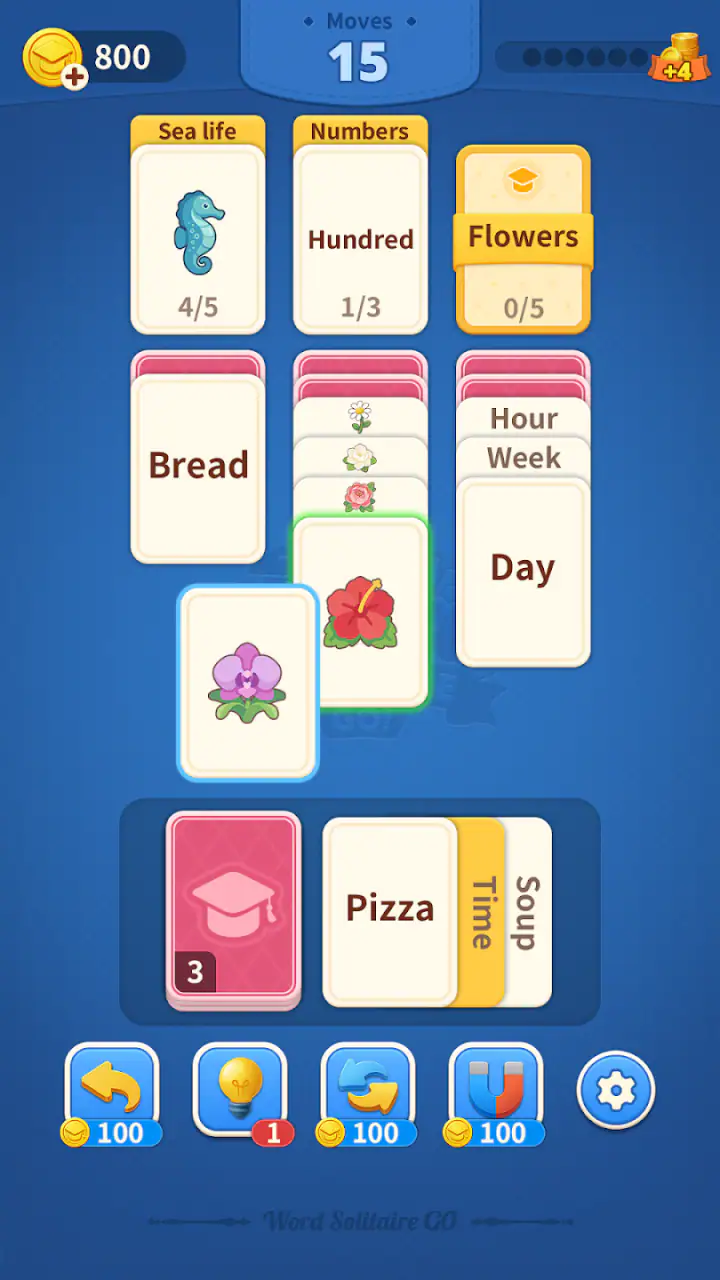
The opening appeal is immediate: I look at a collection of words, try to recognize relationships between them, and arrange them into sensible groups. The solitaire influence matters because the experience feels organized rather than frantic. I am not simply answering isolated vocabulary questions. I am gradually clearing a board of possibilities, which gives each correct group a visible sense of progress.
That structure creates an early goal without needing a complicated tutorial. My first objective is simply to understand how the words relate and to avoid wasting a promising combination too soon. The game encourages observation before action. I found that I naturally started scanning for the most obvious group, then using the remaining words to narrow down the less certain choices.
This is a useful design for casual players because the rules can be learned through play. Someone who enjoys crossword clues, word searches, or card solitaire should be able to understand the central loop quickly. At the same time, it is not just a vocabulary test. A player may know every word on the screen and still make a poor move by grouping them according to a tempting but incomplete connection.
Related News






The first few rounds also show why the format works well on a phone. A puzzle can be approached in a few minutes, and the mental task is self-contained. I can play while waiting for an appointment, during a quiet coffee break, or at the end of the day when I want to focus on something small. It does not demand the uninterrupted attention of a long story game, but it is active enough to keep my mind involved.
Small goals are more important than flashy rewards
What kept me interested at the beginning was not a dramatic reward system. It was the simple satisfaction of reducing uncertainty. At first, several words may appear to fit together, but every group I solve changes the shape of the remaining puzzle. That creates a chain of small decisions: identify a likely set, check whether it leaves sensible leftovers, and revise if the remaining words become impossible to arrange.
For new players, my practical advice is to resist committing to the first plausible group. I get better results by identifying two or three possible relationships and choosing the one that is most specific. Broad categories are dangerous because they can overlap with another intended group. A narrower connection usually gives the rest of the board more room to reveal itself.
Gallery
This is one of the game’s less obvious strengths. The early goal is not merely to find words that belong together; it is to find the grouping that produces the cleanest overall solution. That difference gives the game more thoughtfulness than its relaxed presentation might suggest.
Progress signals and the feeling of moving forward
A word puzzle needs some way to make progress feel meaningful, especially when its individual rounds are short. Here, the clearest progress signal is the puzzle itself becoming more orderly. Each successful group removes confusion and confirms that my reading of the board was sound. The reward is modest, but it is immediate and understandable.
I appreciate that this kind of feedback does not interrupt the main activity. The game’s identity stays centered on solving rather than on collecting unrelated bonuses. For players who prefer a clean puzzle loop, that is a positive. The downside is that people who need a strong sense of long-term progression may find the motivation quieter than in games built around elaborate unlock trees, characters, or equipment.
The title’s solitaire-style structure gives completion a second layer. I am not only spotting word relationships; I am also trying to clear the available choices in a controlled order. That makes the act of finishing a board feel closer to completing a small card layout than answering a quiz. The distinction is important because it rewards planning and restraint, not just quick recognition.
In practical use, I found it helpful to treat each round as a short mental reset rather than as a campaign mission. If I have only a few minutes, I can focus on one puzzle and stop naturally after completing it. If I have more time, I can continue because the basic loop remains easy to re-enter. This flexible stopping point is valuable for a mobile game, particularly for people who do not want a session to expand into an hour without noticing.
Where the progress system may feel thin
The same simplicity that makes the game approachable can also limit its pull. Players who expect frequent unlocks, visible collections, or a detailed map may not find enough external progress to sustain them indefinitely. The game’s momentum comes mainly from solving more puzzles and improving personal confidence, so its appeal depends on whether that kind of progress feels rewarding to you.
I would describe this as a deliberate trade-off rather than a flaw in isolation. A large progression system could distract from the word-solving itself, while a minimal structure keeps the experience calm. Still, anyone choosing it as a long-term main game should understand that the satisfaction is likely to come from mastery and routine, not from a constant stream of new game systems.
The free entry point makes it easy to test that balance. There are in-app purchases ranging from $0.99 to $99.99 per item, so I would approach the optional spending carefully and decide whether the core loop already gives me enough value before buying anything. For a casual player, the sensible approach is to play naturally first rather than assuming that spending is necessary to enjoy the puzzles.
Difficulty, ambiguity, and the shape of the challenge
The challenge in Word Solitaire Go comes from ambiguity more than speed. A word can belong to several broad ideas, and the puzzle asks me to identify the intended relationship. That makes the difficulty feel different from a standard anagram game. I am not only searching for a correct spelling or a hidden word; I am evaluating how several answers fit together at once.
That design supports a gradual learning curve because players can improve their process even when their vocabulary does not change dramatically. I became more cautious about categories that were too general and more attentive to words that looked unusually specific. I also learned to use the remaining board as evidence. If one proposed group leaves a strange collection of words, it is probably not the best route, even if the group itself seems defensible.
A useful technique is to separate certainty levels. I mentally divide the board into words that have one clear relationship, words that could fit two groups, and words that are currently unexplained. I then solve the strongest group first while protecting the ambiguous words. This prevents an early guess from forcing several later mistakes and makes the solitaire-style clearing process feel more deliberate.
Another good habit is to check the whole arrangement before confirming a group. A set of four related words can still be a trap if the remaining words form a much more coherent alternative. This is where the game earns its “puzzle” identity. The best move is often the one that makes the entire board simpler, not the one that looks most convincing in isolation.
Who will enjoy the challenge, and who may not
I think the challenge suits players who like language patterns but do not want a timed contest. It is also a good fit for people who enjoy solitaire because the satisfaction comes from orderly completion and careful sequencing. The Everyone rating makes it approachable for a wide age range, although younger players may still find some word relationships more difficult depending on their reading experience.
On the other hand, players seeking rapid action, competitive rankings, or a highly dramatic difficulty curve should look elsewhere. This is not the right choice if the main attraction is pressure, reflexes, or social competition. It is also less suitable for someone who dislikes puzzles with more than one plausible interpretation. When a category feels ambiguous, the game asks for patience and deduction rather than immediate certainty.
Compared with a crossword, the experience is more compact and less dependent on clues. Compared with a word search, it asks for meaning rather than visual scanning. Compared with traditional solitaire, it replaces card values and suits with linguistic relationships. Those comparisons explain its niche: it is best for someone who wants the quiet rhythm of solitaire with the mental flexibility of a word puzzle.
Pacing, retention pressure, and the reason to return
The pacing is deliberately gentle. I can enter a session without preparing for a long commitment, and the basic activity remains understandable even after I have been away from it. That makes the game well suited to habitual use. A player can build a small routine around it, such as solving a puzzle with breakfast or using one round as a screen break between tasks.
Its retention pressure is therefore subtle. The game does not need to overwhelm me with constant urgency because each unfinished puzzle already creates a small open loop. I want to see whether my suspected group works and whether the remaining words resolve cleanly. That is enough to encourage another round, provided I enjoy the act of sorting itself.
The trade-off is that a relaxed pace can become repetitive if the underlying word relationships stop feeling fresh. Since the core activity stays focused on grouping and clearing, long sessions may be less engaging than short ones. I would personally use it in compact bursts rather than expecting it to replace a larger puzzle collection. The game is strongest when it gives my attention a tidy, bounded task.
For an everyday scenario, imagine finishing a commute with ten quiet minutes before your next obligation. A competitive game might leave you frustrated if you have to stop suddenly, while a narrative game might not provide enough time to settle in. This one can fit that gap more naturally. I can begin a puzzle, make a few careful deductions, and either finish or pause without losing the sense of what I was doing.
Spending, stopping, and choosing the right session length
The presence of optional purchases is worth considering because the game’s relaxed design may appeal to people who want a low-pressure experience. My recommendation is to treat the free version as the test of whether the puzzle loop works for you. If you enjoy solving groups without needing extra incentives, then the game has already demonstrated its main value.
I would also avoid turning every difficult board into a reason to spend. A failed attempt can be useful because it reveals which kinds of broad connections mislead me. Taking a short break and returning with a fresh view is often a better fit for this type of puzzle than forcing an answer immediately. That approach preserves the game’s calm character and helps distinguish genuine difficulty from simple mental fatigue.
Because the age rating is Everyone, it can work as a shared word activity for families, though the best experience will depend on each player’s vocabulary. I can imagine two people discussing possible groups without needing a competitive mode. That cooperative conversation is an advantage over solitary word searches, even though the game itself remains a personal puzzle experience.
My progression verdict after weighing the whole loop
Word Solitaire Go succeeds because its goals and challenge are closely connected. The early objective is clear, the progress signal is visible in the board becoming cleaner, and the difficulty comes from making good choices among overlapping possibilities. It does not need an elaborate unlock structure to make a single puzzle satisfying. For me, that focus is the main reason to recommend it.
My strongest tip is to play it as a logic exercise rather than a vocabulary speed test. Look for the most distinctive relationships, keep ambiguous words aside, and judge every proposed group by what it leaves behind. This method makes the game more manageable and exposes the deeper strategy that a quick glance at its store summary might miss.
I would recommend it to casual word-game fans, solitaire players who want a fresh variation, and anyone looking for a quiet mobile activity that fits naturally into short breaks. The free price makes trying it straightforward, while the Everyone rating broadens its usefulness for family-friendly play. Nebula Studio has kept the central idea focused enough that I can understand the appeal within one session.
I would skip it if I need constant unlocks, competitive pressure, action, or a large variety of modes. The progression is intentionally restrained, and the same focused loop that feels relaxing to one player may feel repetitive to another. Players who prefer crosswords may also miss clue-based solving, while traditional solitaire fans may want more card-specific strategy than this word format provides.
Overall, the best reason to keep playing is the gradual improvement in how you read the board. I start by seeing a pile of possible connections and end by recognizing which relationships are strong, which are distractions, and which order is safest. That is a modest but genuine form of progression. For a free word game built around solitaire-style puzzles, it gives the experience enough depth to support regular short sessions without pretending to be something louder or more complex.
My final view is positive but specific: this is a focused companion game, not an all-purpose puzzle platform. When I want a calm mental reset, its word grouping and orderly clearing provide exactly that. When I want a deep campaign or a high-pressure challenge, I would choose another category. Within its narrow lane, however, Word Solitaire Go offers a clean, approachable way to turn a few spare minutes into a small exercise in language, deduction, and patience.
FAQs for Word Solitaire Go
What is Word Solitaire Go and how is it played?
Word Solitaire Go combines classic solitaire-style card movement with word-building challenges. Instead of only arranging cards by suit, you use available letters or letter cards to form valid words and clear the board. Each level usually has a specific objective, and planning your moves carefully is important because limited spaces, blocked cards, or restricted turns can make an otherwise simple puzzle more difficult.
Does Word Solitaire Go require an internet connection?
Word Solitaire Go may allow you to play many of its core levels offline after installation, which is useful when traveling or using mobile data sparingly. However, an internet connection can still be required for advertisements, cloud synchronization, leaderboard features, special events, updates, or in-app purchases. Availability of offline functionality may also vary depending on the version and device.
Is Word Solitaire Go free to download and play?
Word Solitaire Go is generally available as a free download, but the free version may include advertising and optional in-app purchases. Purchases can sometimes provide extra hints, additional lives, boosters, or an ad-free experience. You can normally progress without paying, although difficult stages and limited resources may encourage optional purchases, so checking the store listing is recommended before downloading.
Is Word Solitaire Go suitable for children and English learners?
Word Solitaire Go can be suitable for older children, teenagers, and adults who enjoy vocabulary puzzles, particularly because it encourages spelling, word recognition, and strategic thinking. Nevertheless, the difficulty and vocabulary may vary by language and level. Parents should review the app’s age rating, advertising, privacy information, and purchase settings before allowing younger children to play.
What are the main advantages and possible drawbacks of Word Solitaire Go?
The main advantages of Word Solitaire Go are its combination of familiar solitaire mechanics and vocabulary gameplay, short levels that fit quick play sessions, and progressively more challenging puzzles. Possible drawbacks include repetitive gameplay after extended sessions, advertisements in the free version, dependence on hints when a board becomes difficult, and limited enjoyment for players who do not like word games or card-based puzzles.
Pros
- Combines classic solitaire with relaxing word-building challenges.
- Short rounds make it easy to play during quick breaks.
- Progression system provides goals beyond simply clearing cards.
- Clean interface keeps the focus on cards and available letter moves.
- Suitable for players who enjoy both vocabulary and casual puzzle games.
Cons
- Some levels may feel repetitive after extended play sessions.
- Difficulty can vary noticeably between consecutive puzzles.
- Hints or extra moves may be limited unless earned or purchased.
- Requires careful planning
- which may frustrate players seeking pure solitaire.
- Ads may interrupt the experience in the free version.


